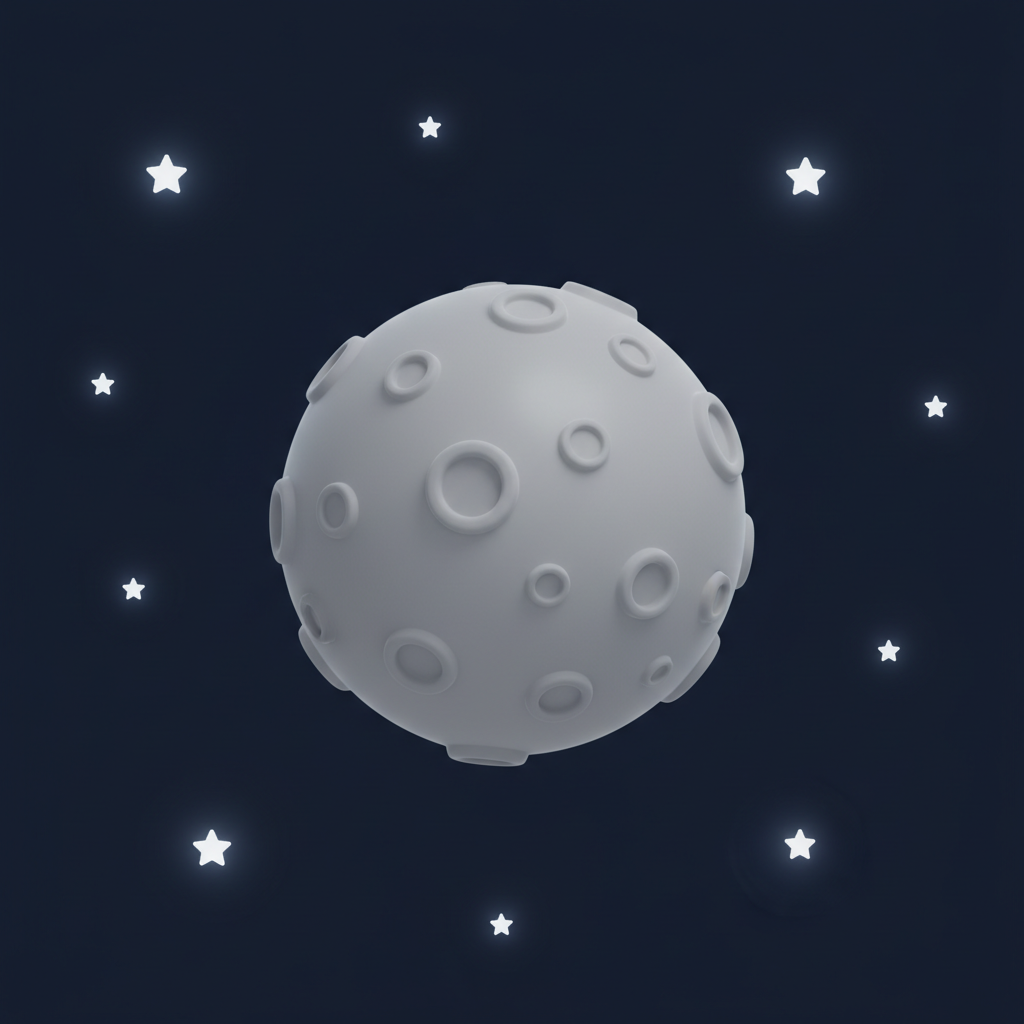
As Byeol-maru drew close to the Moon’s surface, the screen filled edge to edge with round craters big and small, endlessly overlapping and layered on top of each other, as if someone had stamped circles across the entire surface.
Hyeongseop’s eyes went wide as he stared at the sight. He had never seen this many pits and hollows back on Earth.
“Byeoli, why does the Moon have so many craters? Earth doesn’t have nearly this many.”
“Those are called craters, marks left behind by countless big and small rocks crashing into the surface over an enormous span of time. Space has plenty of rocks drifting around, and the Moon ends up keeping every single mark they leave.”
“But wouldn’t the same rocks come flying toward Earth too?”
“They do. But Earth has a thick layer of air, so most small rocks burn up completely before they ever reach the ground. Earth also has wind, rain, and volcanic activity, which slowly erase old scars over time.”
“What about the Moon, then?”
“The Moon barely has any air at all, so rocks slam straight into the surface without burning up. And with no wind, rain, or volcanoes to smooth things over, once a crater forms, it can stay looking almost exactly the same for hundreds of millions of years.”
Hyeongseop studied each crater closely. Some were huge, some tiny.
“What’s that giant one over there? It looks way bigger than the rest.”
“That’s an enormous crater on the far side of the Moon, one of the biggest impact scars in the whole solar system. Its width is far larger than the combined length of North and South Korea. Something truly massive crashed there a very long time ago.”
“So when did all these craters actually form?”
“Some formed billions of years ago, others more recently, just a few million years back. Craters are like the Moon’s ancient diary. Marks that would have vanished on Earth long ago have stuck around here, quietly telling that history.”
“Did Earth used to have this many craters too?”
“Of course. When Earth was young, it was probably struck by just as many rocks, maybe even more. But over billions of years, most of those marks got worn away by wind and rain, buried under fresh volcanic rock, or shifted around as continents moved. The handful of craters still visible on Earth today are the lucky few that managed to survive.”
Hyeongseop suddenly felt grateful for Earth’s thick blanket of air. Thanks to that air, Earth kept a smooth, mostly unscarred face, while the Moon carried every mark on its skin instead, telling its long, ancient story without ever forgetting a single chapter.
How Much Did You Remember?
- Why does the Moon have so many craters?
- Why doesn’t Earth keep as many craters?
- Why do lunar craters barely fade even after hundreds of millions of years?
- Did Earth once have lots of craters too?
(Answers: 1. Marks left by countless ancient impacts. 2. Air, weather, and volcanic activity erase them. 3. No air, weather, or volcanoes to smooth them over. 4. Yes, but most have since vanished.)
답글 남기기