“Dad, stars are way too far away to ever touch. So how do scientists know what they’re made of?”
“They analyze the light. There’s actually an enormous amount of information hiding inside starlight.”
“Information hiding inside light?”
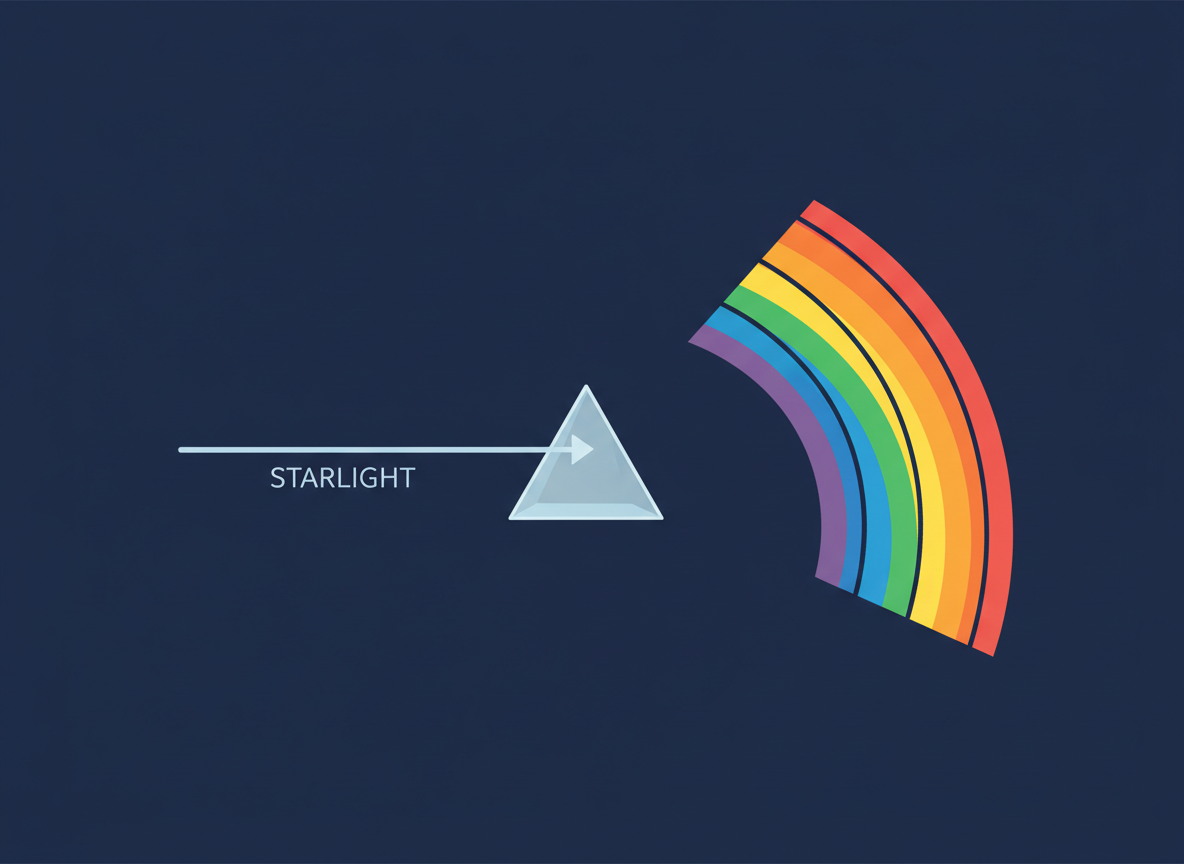
“Yep. If you pass light through a prism, it spreads out into a rainbow. But if you spread out starlight that way, you’ll see thin dark lines scattered between the rainbow colors.”
“What are those dark lines?”
“They show up because the elements making up that star each absorb a tiny bit of light at a specific color. And here’s the fun part, every element absorbs at a different position. Each one has its own unique pattern, almost like a fingerprint.”
“So looking at that pattern tells you which element it is?”
“Exactly. Scientists already figured out on Earth, through experiments, exactly what pattern hydrogen, helium, iron, and other elements each create. So when you look at a star’s pattern and compare it to those Earth experiments, you can tell exactly which elements that star contains.”
“Did they study the Sun this way too?”
“Of course. This method is how we found out the Sun is mostly made of hydrogen and helium. In fact, the element helium itself was discovered by analyzing sunlight before it was ever found here on Earth.”
“Whoa, they found it on the Sun before finding it on Earth?”
“That’s right. That’s actually where its name comes from, the Greek word for the Sun, ‘helios.’ Isn’t it amazing that just from light, you can figure out what a star is made of, even one hundreds of millions of kilometers away?”
“Thin lines hidden inside light become a fingerprint that reveals what a star, hundreds of millions of kilometers away, is actually made of.”
Your Turn Now
Share with someone today what you remember.
- What do you see when you spread starlight through a prism?
- Why do those dark lines appear?
- Where was the element helium discovered first?
(Check when ready: 1. Dark lines scattered between the rainbow colors. 2. Elements absorb light at specific colors. 3. In sunlight, before it was found on Earth.)
답글 남기기