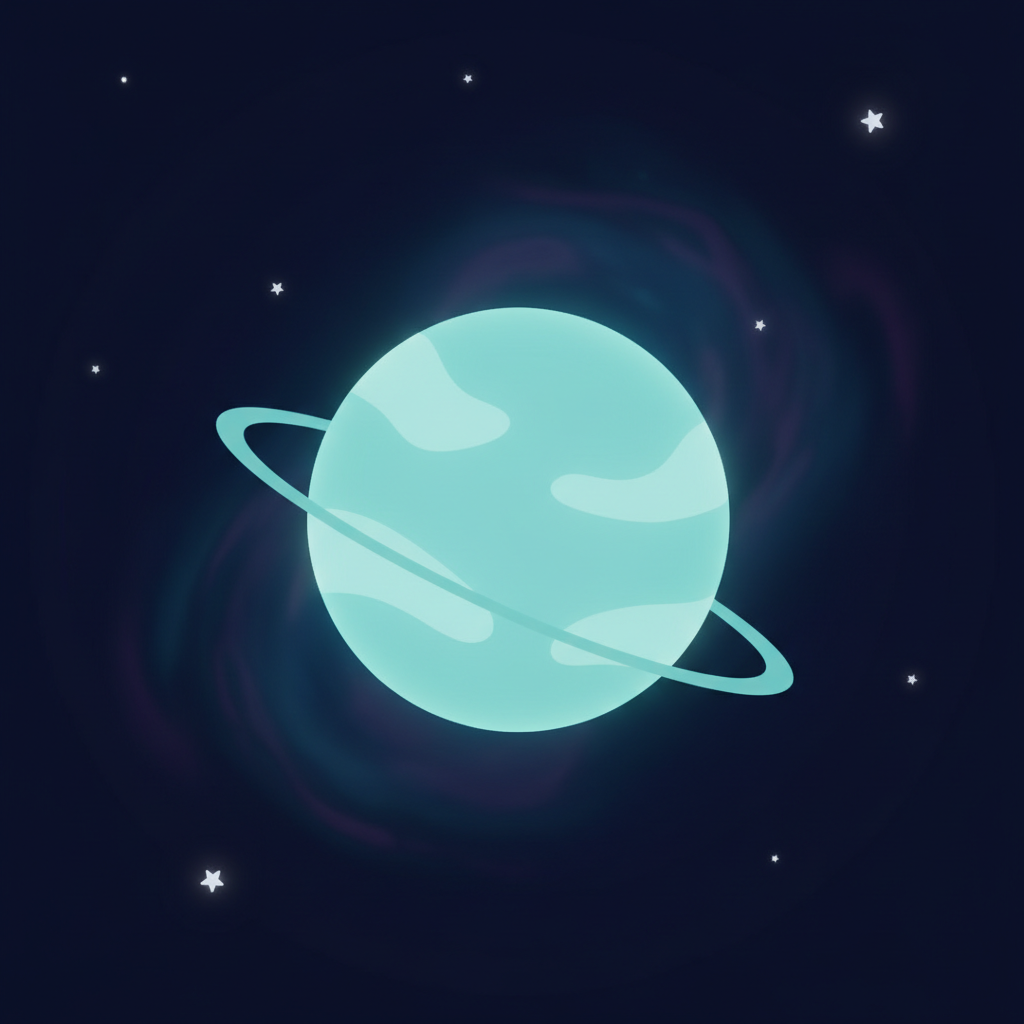
Byeol-maru approached a pale, blue-green planet. It looked like a clear sky-colored marble, yet something about it seemed off. A thin ring stood upright around it.
“Byeoli, this planet’s ring is standing up! Saturn’s ring was lying flat.”
“Right, but it’s not the ring that’s standing, it’s the planet that’s lying down. This is Uranus. Most planets spin almost upright like tops, but Uranus travels around the Sun lying on its side, like a rolling ball.”
“Why is it lying down?”
“Many scientists think it was hit hard by a giant object long ago. It isn’t certain, but it’s a convincing explanation.”
“What changes when a planet lies on its side?”
“The seasons get really strange. Uranus takes 84 Earth years to circle the Sun once. And because it’s tipped over, its north and south poles take turns facing the Sun head-on. So near the poles, the Sun stays up for 42 years straight, and then it stays below the horizon for the next 42 years.”
“42 years? That’s as old as my dad!”
“Ha, exactly. A single season on Uranus lasts 21 years. A child born there would have to be over twenty to see their first season end.”
Byeoli pulled up an old drawing on the screen. It showed a person sitting beside a small telescope.
“The person who found this planet was William Herschel, in England in 1781. He was originally a musician, but he loved the night sky so much that he built his own telescopes. One night he spotted a strange object that looked like a small round disk instead of a twinkling point. At first, he thought it was a comet.”
“But it turned out to be a planet?”
“Yes. After watching it for months, he saw that it had no tail and followed a round path. It was the first new planet found with a telescope, besides the five visible to the naked eye. Until then, people believed the solar system ended at Saturn, and overnight it became twice as wide.”
“Wow, so is the name Herschel’s?”
“Herschel wanted to name it after the king of England at the time, George the Third. But scientists in other countries objected, and in the end it was named Uranus, after the Greek god of the sky.”
“Has any spacecraft ever gone close to Uranus?”
“Just one. In 1986, Voyager 2 flew past it. Even now, the only close-up pictures of Uranus are the ones it took. Voyager 2 also found ten new moons, and on one of them, Miranda, there’s a cliff more than twice as tall as Mount Everest.”
“There’s still so much we don’t know.”
“Right, Uranus is full of mysteries. Unlike Jupiter and Saturn, which are mostly gas, it contains lots of frozen water, ammonia, and methane ices, so it’s sometimes called an ice giant.”
Hyeongseop felt as though the blue marble outside the window was holding a secret that hadn’t yet been unlocked.
“Byeoli, where to next?”
“At last, the final planet of the solar system. The farthest place we’ve seen so far, and the one with the fiercest winds.”
As Byeol-maru picked up speed, the blue marble outside slowly shrank. Beyond it, in the darkness, a deep, rich blue glow began to shimmer faintly.
(To be continued — Episode 7: Neptune, the Last Planet of the Solar System)
답글 남기기