International Space Station Story Trilogy · Part 1
Just after the Sun had set, Hyeongseop and Byeoli climbed up to the rooftop. The sky was turning deep navy, and a trace of red sunset still lingered in the west.
“Byeoli, what are we here to see?”
Byeoli held out a screen showing a stargazing app.
“At the time the app gave us, the International Space Station will pass over our neighborhood. You’ll be able to watch it cross the sky for a few minutes.”
“We can see the station with our own eyes? Without a telescope?”
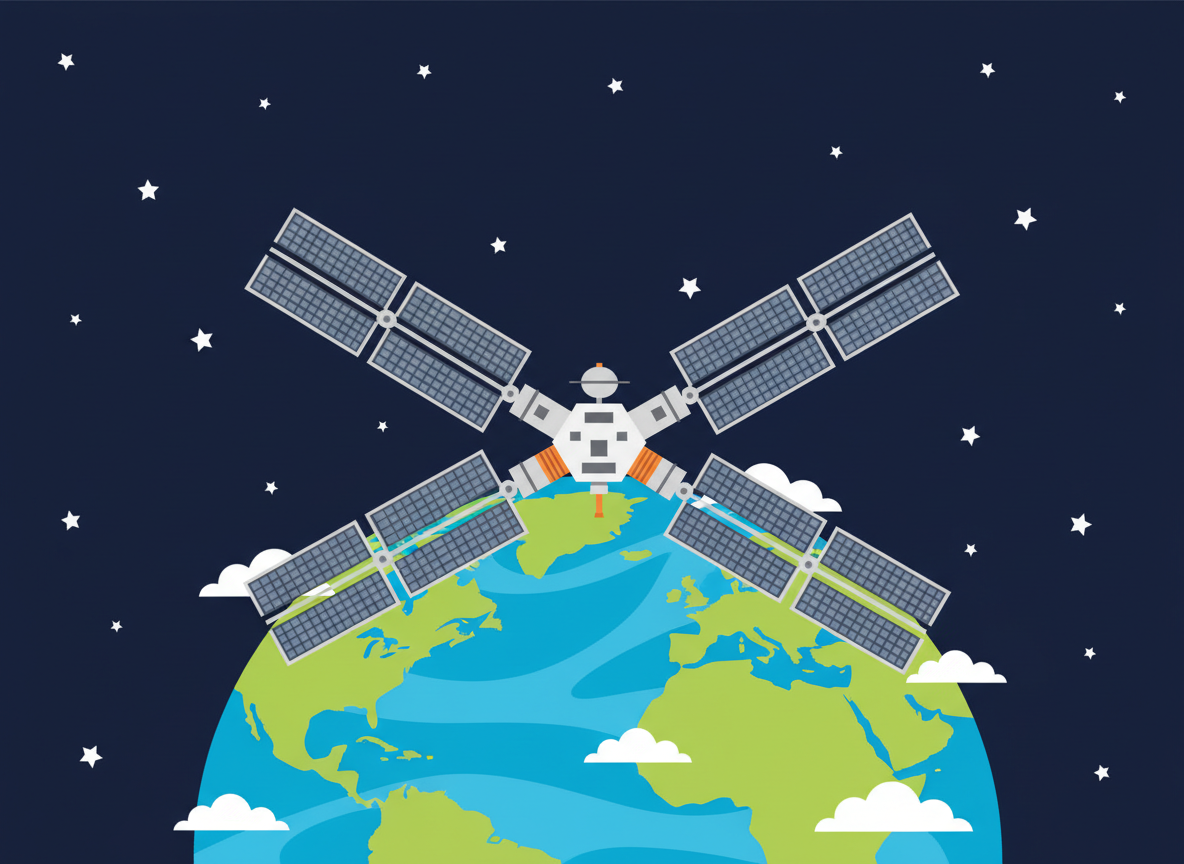
“Yes, no telescope needed. The station is about the size of a football field, and its solar panels reflect sunlight like mirrors. It weighs about 420 tons, around 60 elephants’ worth, and it flies 400 kilometers above the Earth.”
As the time drew near, Byeoli pointed at the western sky.
“Three, two, one… look there!”
A bright dot rose in the low western sky. It was far brighter than any star, with a clean white glow. It didn’t blink and made no sound as it quietly glided across the sky.
“Wow, how is it different from an airplane?”
“Airplanes have red and green lights that blink, and they make noise. The station doesn’t blink. It moves smoothly as one bright light. And it’s really fast, flying at 28,000 kilometers per hour.”
“Could it be a shooting star?”
“A shooting star flashes and vanishes in a second or two. The station crosses the sky slowly for several minutes at the same brightness.”
“Does the station shine on its own?”
“No, we see it because it reflects sunlight. It’s dark where we are because the Sun has set, but sunlight still reaches the station 400 kilometers up. That’s why we can only see it for a few hours before sunrise or after sunset. In the middle of the night, the station is inside Earth’s shadow too, so we can’t see it.”
The bright dot passed the middle of the sky, headed east, and suddenly vanished.
“Huh? It disappeared!”
“It slipped into Earth’s shadow. Without sunlight, it goes out like a light switched off.”
Hyeongseop waved toward the part of the sky where it had vanished.
“The astronauts inside can’t see me, right?”
“That’s okay. You’ve seen with your own eyes that people are living up there right now.”
“Can I see it any bigger?”
“To the naked eye it’s only a dot, since it’s 400 kilometers away. But a photo taken through a big telescope can even show the shape of its solar panels.”
“Can I see it again?”
“Yes. The station circles the Earth every 90 minutes, so chances come often. But good sightings from our neighborhood happen anywhere from once or twice a week to once or twice a month, so turn on the app’s alerts and you won’t miss one.”
Try It Tonight
Choose your neighborhood in NASA’s Spot the Station app or website, and it will tell you when and from which direction the station passes (it’s free). Turn on notifications, and when the time comes, look up in the direction the app shows. Use a stopwatch to time how long the station takes to cross the sky, and write down where it appeared and where it disappeared. If it’s cloudy, you won’t see it.
How Much Do You Remember?
- About how big is the International Space Station?
- Why does the station look so bright in the night sky?
- How can you tell the station apart from an airplane?
- Why can’t you see the station in the middle of the night?
(Answers: 1. About the size of a football field. 2. Its solar panels reflect sunlight like mirrors. 3. The station doesn’t blink and moves silently as one steady bright light. 4. It’s inside Earth’s shadow and gets no sunlight.)
답글 남기기