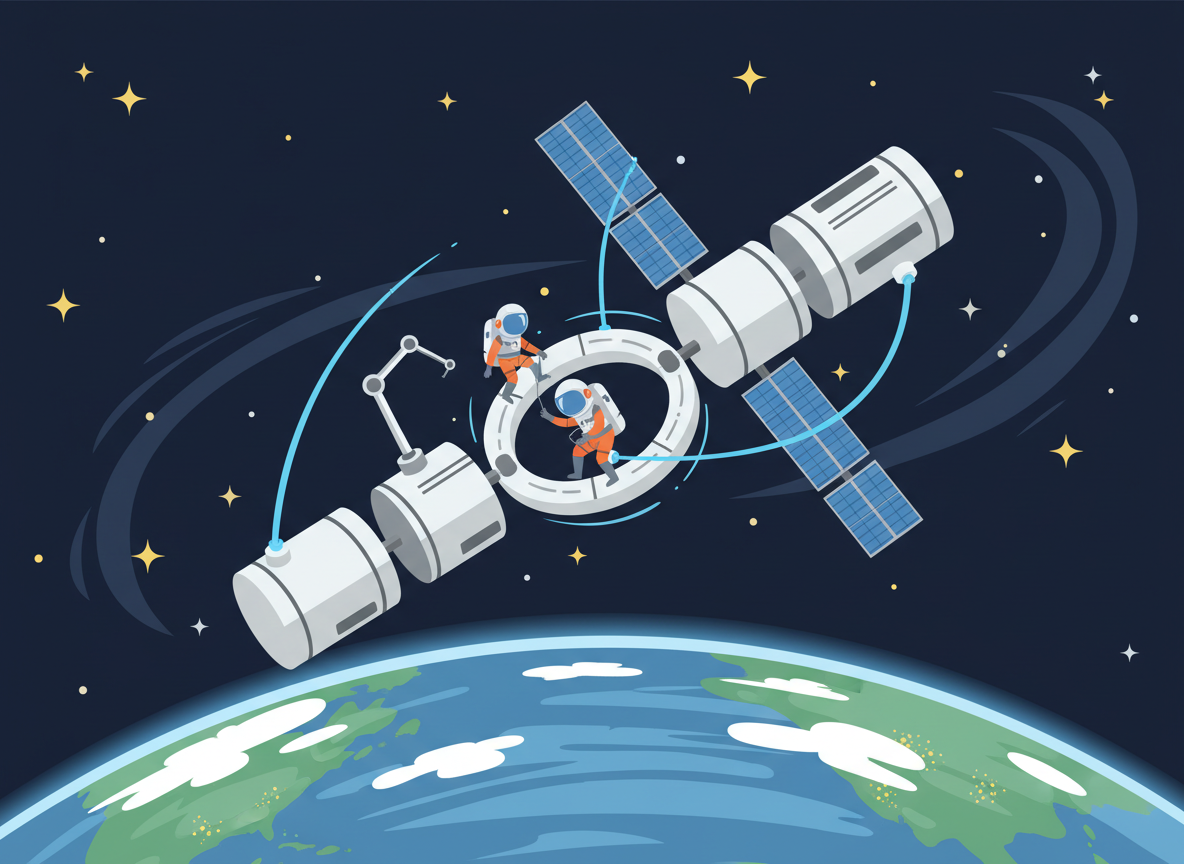
International Space Station Story Trilogy · Part 3
Byeol-maru stopped beside the International Space Station. Hyeongseop looked up at the enormous station with its solar panels spread wide.
“Byeoli, how did they build something this big? You can’t launch it on a single rocket.”
“Right. It weighs over 400 tons, and no rocket can carry that all at once. So they built it in pieces on Earth, like Lego, launched them into space one by one, and joined them together.”
Byeoli brought up an old video on the screen. It was 1998.
“That November, the first piece, Zarya, built by Russia, went up. About two weeks later, Unity, built by the United States, rode up on the Space Shuttle and was connected. They launched pieces like that about forty times, and it took far more than ten years to finish.”
“Who built it?”
“Five space agencies worked together, from the United States, Russia, Europe, Japan, and Canada. These were countries that once competed against each other in space.”
“How big is the station they built?”
“About the size of a football field. With the solar panels, it’s around 100 meters long, and it flies at 28,000 kilometers per hour, circling the Earth about sixteen times a day.”
“How did they connect the pieces?”
“Astronauts put on spacesuits and went outside on spacewalks to tighten bolts and connect cables. The big pieces were moved with a robotic arm more than 17 meters long.”
“So is it finished now?”
“Yes. And since November 2000, people have lived there without a break for more than 25 years. More than 270 people from over 20 countries have visited.”
Hyeongseop imagined people from different countries living together in one home. It was a home in the sky where people with different languages and cultures ate and worked together.
“So will this station be around forever?”
“No, it has a lifespan. The current plan is to use it until 2030 and bring it safely down to Earth in early 2031. But some people want to keep using it longer, so the schedule could change.”
“How will they bring it down?”
“It’s too big to simply drop. So a special spacecraft is being built. It will slowly push the station into Earth’s atmosphere, where most of it burns up from friction. Whatever remains is aimed at an ocean spot called Point Nemo. It’s about 2,700 kilometers from the nearest land, the most remote place in the ocean. It’s even called the spacecraft graveyard.”
“Then where will astronauts stay once the station is gone?”
“Several private companies are preparing new space stations. But they’re still in preparation, so we’ll have to see how it turns out.”
Hyeongseop felt a strange tug at his heart that a home built by people from different countries would one day retire. Outside Byeol-maru’s window, the station glittered as it slowly passed by.
Build a Space Station from Boxes
Gather three or four empty boxes (snack boxes or tissue boxes) and decorate each as a room (a module). Make solar panels out of colored paper or foil, and tape them on. Finally, tape the rooms together. Building the rooms separately and joining them in orbit is how the real space station was built.
“Five space agencies built the International Space Station in pieces over more than ten years, and the current plan is to retire it around 2030 and bring it safely down into the ocean at Point Nemo.”
Your Turn
- Why was the space station launched in pieces?
- How many space agencies built it together?
- What is the name of the remote ocean spot where the station is planned to come down?
(Check when you’re ready: 1. It was too big and heavy for any single rocket. 2. Five. 3. Point Nemo.)
답글 남기기