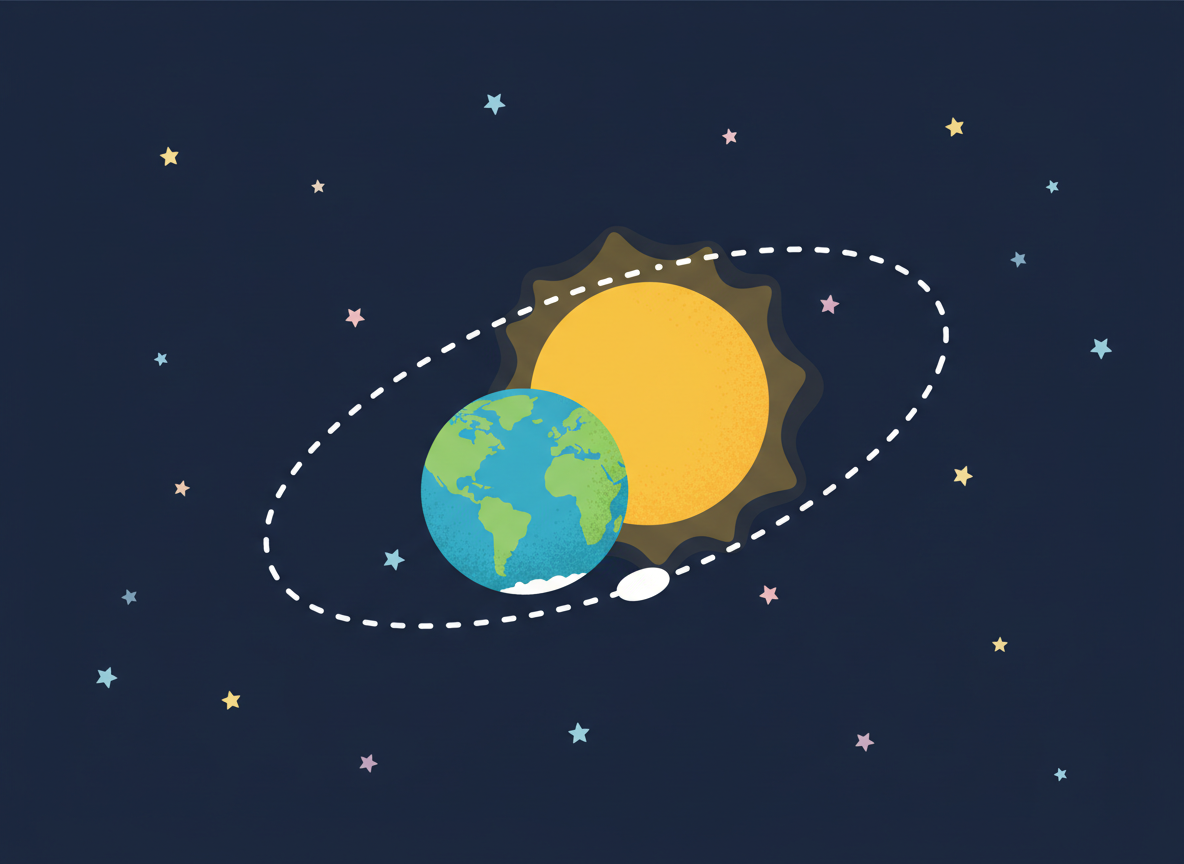
On a sweltering midsummer afternoon, with cicadas buzzing loudly outside the window, Seojun was fanning himself when a question suddenly popped into his head.
“Mom, summer is so hot because Earth gets closer to the Sun, right?”
“Actually, no, it’s the exact opposite. Earth is actually closest to the Sun during what’s winter for us.”
“What? That doesn’t make sense, shouldn’t being closer make it hotter?”
“That’s an easy mistake to make, but seasons aren’t caused by distance at all, they’re caused by the fact that Earth is tilted slightly, about 23.5 degrees.”
“Tilted?”
“Yes. Earth doesn’t spin straight up and down, it orbits the Sun while leaning at that angle, and the tilt stays roughly the same all year round.”
“What does that have to do with seasons?”
“As Earth goes around the Sun, sometimes the Northern Hemisphere, the side we’re on, leans more toward the Sun, and sometimes the Southern Hemisphere leans more toward it instead. When our side is tilted toward the Sun, sunlight hits us much more directly and strongly, and that’s summer.”
“So what about the Southern Hemisphere?”
“The opposite. When we’re having summer, they’re having winter. That’s why countries like Australia or Brazil have Christmas in the middle of summer.”
“Wow, that’s wild. So does the distance between Earth and the Sun have nothing to do with it at all?”
“Not nothing, but the effect is tiny. Earth is actually closest to the Sun in January and farthest in July. But here, January is cold and July is hot. So that tells you the tilt matters way more than the distance does.”
“Is that why summer days feel longer too?”
“Exactly the same reason. When the Northern Hemisphere tilts toward the Sun, the amount of daylight in a day actually gets longer. That’s why it’s still bright out past 8pm in summer, but it gets dark by 5pm in winter.”
“So longer days and hotter weather both come from the same cause.”
“So what if Earth wasn’t tilted at all?”
“Then there wouldn’t be seasons at all. The weather would stay pretty much the same all year round. Being able to feel spring, summer, fall, and winter like we do now, that’s actually thanks to that small tilt.”
“Why did the tilt happen in the first place?”
“Scientists think that a very long time ago, right after Earth first formed, it collided with a large object, and that’s what knocked it into this tilt. It’s amazing to think that one ancient collision is the reason we get to feel the seasons change every single year.”
Seojun set down his fan and glanced up at the sun in the sky. Somehow, it felt even more amazing to think that this heat wasn’t really about the Sun at all, it was because the Earth we’re standing on is tilted just a little off-center.
“Seasons aren’t caused by how close Earth is to the Sun. They’re caused by Earth’s slight tilt. That small tilt is the reason we get to feel four different seasons every year.”
Your Turn Now
Share with someone today what you remember.
- When is Earth actually closest to the Sun?
- What’s the real reason seasons happen?
- Is longer summer daylight caused by the same tilt?
(Check when ready: 1. January, right in the middle of winter here. 2. Earth’s roughly 23.5-degree tilt. 3. Yes, when the Northern Hemisphere tilts toward the Sun, daylight hours get longer too.)
답글 남기기