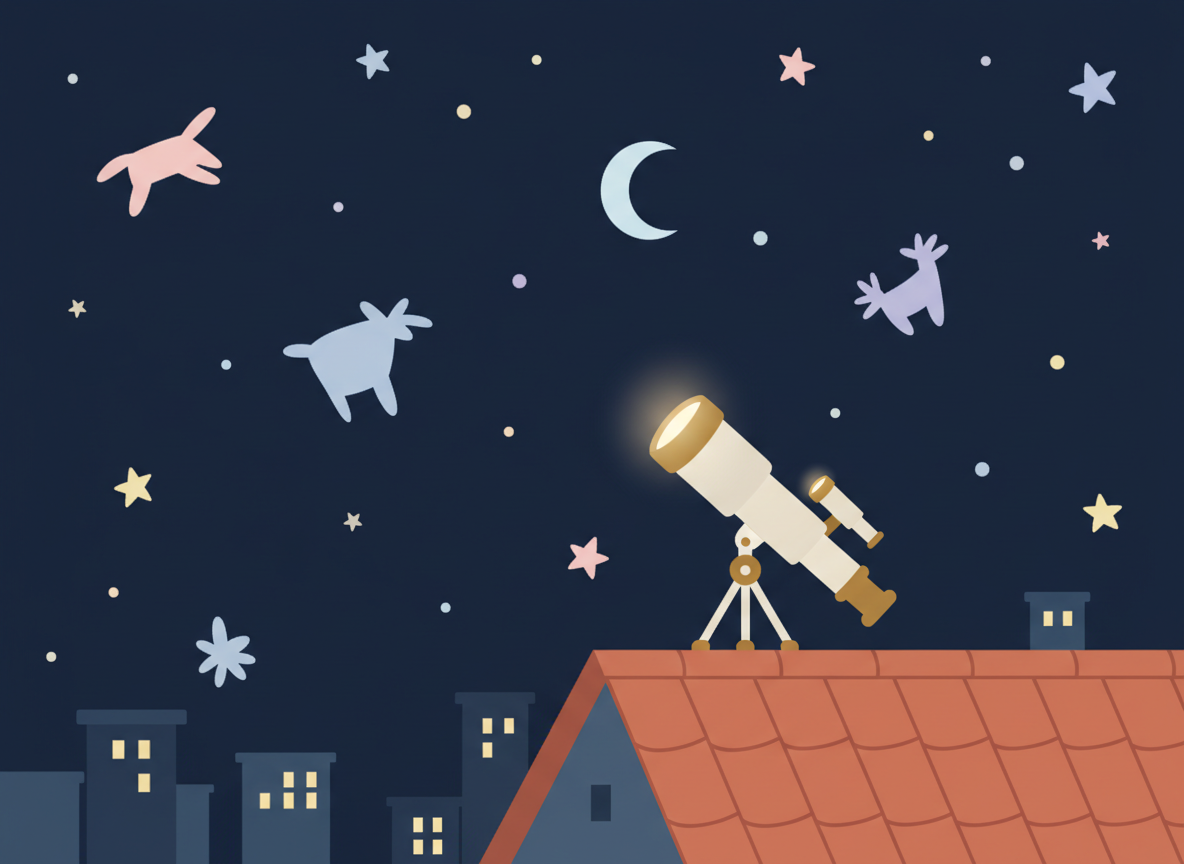
Somewhere tonight, someone your age is looking up at the sky.
Ninety years ago, in a city called Nashville, an eleven-year-old girl did exactly that. Her name was Nancy. She didn’t have a big telescope. She didn’t have a team of scientists. What she had was a book about constellations, a few friends from her neighborhood, and a sky so clear and dark that the stars felt close enough to touch.
Nancy’s mother took her outside every night and taught her the constellations one by one. On lucky nights, she even got to see the aurora. Those nights were Nancy’s favorite thing in the whole world.
So Nancy did something simple. She started a club.
Every week, she and her friends would meet, open their book, and learn one more piece of the sky — which stars made up which shapes, which lights were planets instead of stars, why the moon seemed to change its face each night. Nobody paid them. Nobody wrote about them in a newspaper. They were just a handful of girls, together, wondering.
Later, when Nancy was old enough to apply to college and study the stars for real, someone told her she shouldn’t bother. A college dean said that to her, plainly, to her face. But Nancy had already spent years listening to the sky instead — and the sky had never once told her to stop.
She kept going. She became an astronomer. During her graduate studies, she worked at Yerkes Observatory, where she became the first woman ever on its academic staff. In 1959, she joined NASA — brand new back then, barely a few months old. Two years later, she became NASA’s first Chief of Astronomy, the first woman to ever hold a position like that there.
For the next twenty years, Nancy pushed for something nobody had built before: a telescope that could float above the clouds, above the wind, above the blur of our own atmosphere, and see the universe with perfectly clear eyes. People doubted it could be done. Nancy kept asking, kept explaining, kept believing.
That telescope eventually got a name: Hubble. Today, scientists still call Nancy Grace Roman “the Mother of Hubble” — because without her, it might never have left the ground.
Here’s the part that might make your heart feel warm, the way it makes ours feel warm: Nancy passed away in 2018, but her story didn’t end there.
This week — on August 30th — a brand new telescope launched into space. And this one carries her name: the Nancy Grace Roman Space Telescope.
It will look at the sky one hundred times wider than Hubble ever could in a single glance — like trading a small window for an enormous one. Scientists believe it might discover around 100,000 new planets circling other stars, more than every telescope in history has found combined. It will help us understand why our universe keeps growing faster and faster, a mystery even Einstein once wrestled with.
Here’s a fun detail: Nancy was even included in LEGO’s “Women of NASA” figurine set, a tiny version of her that people can keep on their own desks.
But if you ask us, the most beautiful part of Roman isn’t the mirror, or the numbers, or the rocket. It’s this: a telescope with a hundred-times-wider eye is about to open onto the universe — and it all began with one eleven-year-old girl, a borrowed book, and a few friends who were willing to look up with her.
So tonight, if you find a window, or a backyard, or even just a small patch of sky between buildings — look up. You don’t need a telescope. You don’t need permission. You don’t even need to know the names of anything you see.
You just need to wonder.
That’s exactly how Nancy started. And you never really know, when you’re eleven — or seven, or five — what your own wondering might someday become.
“Nancy Grace Roman was NASA’s first female Chief of Astronomy, known as the ‘Mother of Hubble.’ On August 30, 2026, a new space telescope carrying her name was launched.”
Your Turn Now
Share with someone today what you remember.
- What did Nancy create when she was eleven?
- What role was Nancy the first woman to hold at NASA?
- What happened on August 30, 2026?
(Check when ready: 1. An astronomy club with her neighborhood friends. 2. NASA’s first Chief of Astronomy. 3. A space telescope carrying her name was launched.)
More Space Stories to Read Together
A story adapted from official NASA materials.
답글 남기기