Today’s Question
Is the ocean really pulled in and out twice a day because of the Moon?
Hyeongseop was looking down at Earth’s oceans on Byeol-maru’s screen when he noticed one side of the water bulging outward.
“Byeoli, why does it look like that? The water seems to be piling up on one side.”
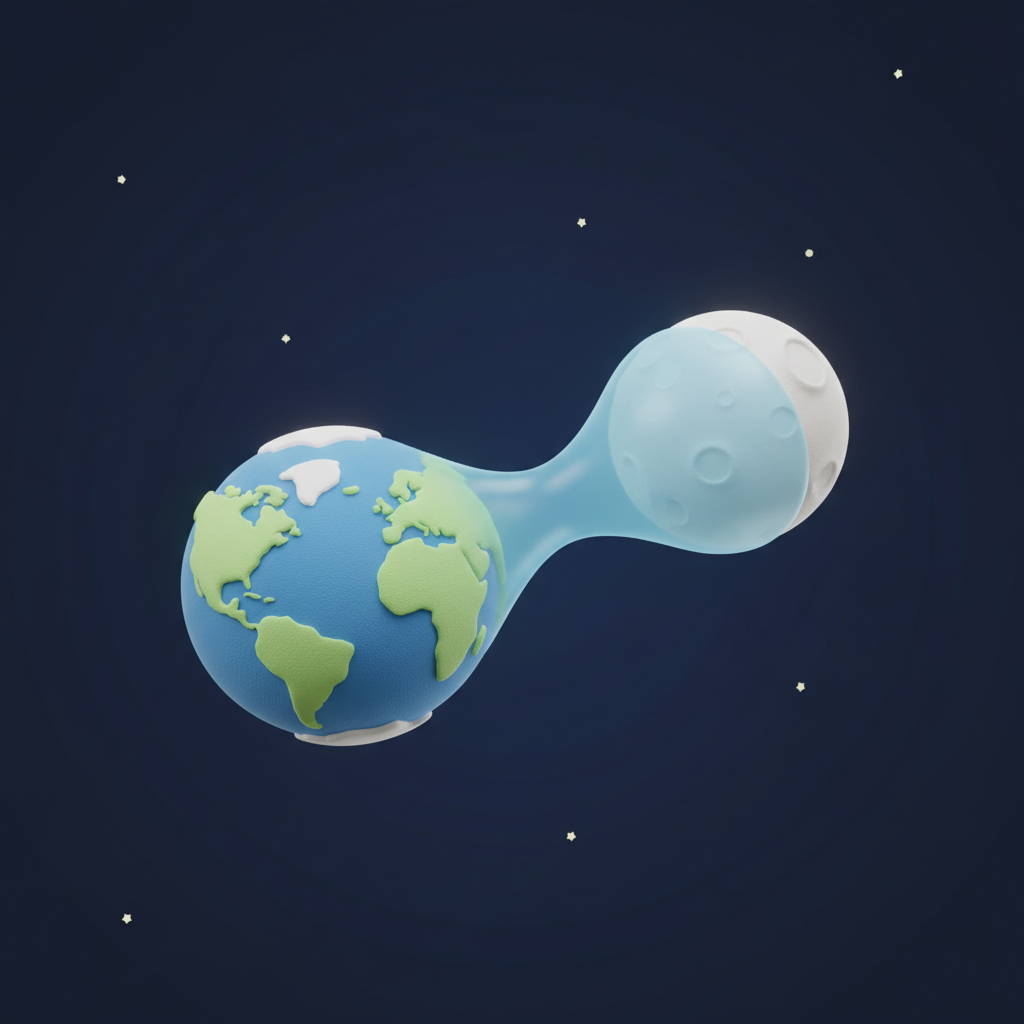
“That’s the Moon’s gravity pulling on Earth’s oceans. The Moon pulls harder on the ocean water closest to it, so the side of the sea facing the Moon bulges outward. That’s high tide.”
“But doesn’t the opposite side, the one not facing the Moon, stay flat then?”
“Surprisingly, it bulges too. The whole Earth gets pulled slightly toward the Moon, but the ocean water on the far side gets pulled a little less, so it lags behind and bulges outward as well. That’s why both sides of Earth swell at the same time.”
Hyeongseop remembered that Earth spins around once a day, like a top.
“So since Earth spins once a day, wouldn’t every coastline pass through those two bulges twice a day?”
“Exactly! That’s why most coastal areas get two high tides and two low tides every single day.”
“Does the Sun have anything to do with tides too?”
“The Sun does have an effect, but a much weaker one than the Moon. The Sun is far bigger than Earth, but it’s so much farther away that its pull is less than half the Moon’s. But when the Sun and Moon line up in a row, during a full moon or new moon, their pulls combine, and the difference between high and low tide gets much bigger than usual. That’s called a spring tide.”
“What about during a half moon?”
“During a half moon, the Sun and Moon sit at right angles to each other, canceling some of each other’s pull out. That’s when the difference between high and low tide is smallest, called a neap tide.”
“What do people actually use spring and neap tides for?”
“Fishermen sometimes plan their fishing around the stronger currents of a spring tide, and mudflat experiences are usually timed for when low tide pulls the water back the farthest. For a long time, people have used the Moon’s shape alone to predict exactly when the sea would pull back, and built it right into daily life.”
“Would there be no tides at all without the Moon?”
“Not entirely none. The Sun’s gravity alone would still create very weak tides. But the big, clear tides we see today are mostly thanks to the Moon. So even though it looks like it’s just quietly floating far away, the Moon is actually the real force moving Earth’s entire ocean every single day.”
Hyeongseop imagined Earth’s oceans swelling and settling like slow breathing, timed to the Moon’s gentle pull. It felt strange to think that the quiet moon hanging far away was actually reaching down to touch the whole ocean, twice a day, every day.
“The Moon’s gravity bulges the ocean on both sides of Earth, and as Earth spins once a day, each coast passes through two high tides and two low tides daily.”
How Much Did You Guess Right? (Mixed True/False)
- (True/False) High tide only happens on the side facing the Moon.
- How many high and low tides happen each day?
- (True/False) The Sun has no effect on tides at all.
- When does a spring tide happen?
- (True/False) Tidal difference is greatest during a half moon.
(Check when ready: 1. False, both sides bulge. 2. Two of each. 3. False, it has a weaker effect. 4. When the Sun and Moon line up. 5. False, it’s smallest then.)
Curious about the Moon and Earth? Read Why Does the Moon Always Show Us the Same Face? and Why Does Earth Have Just One Moon?.
답글 남기기