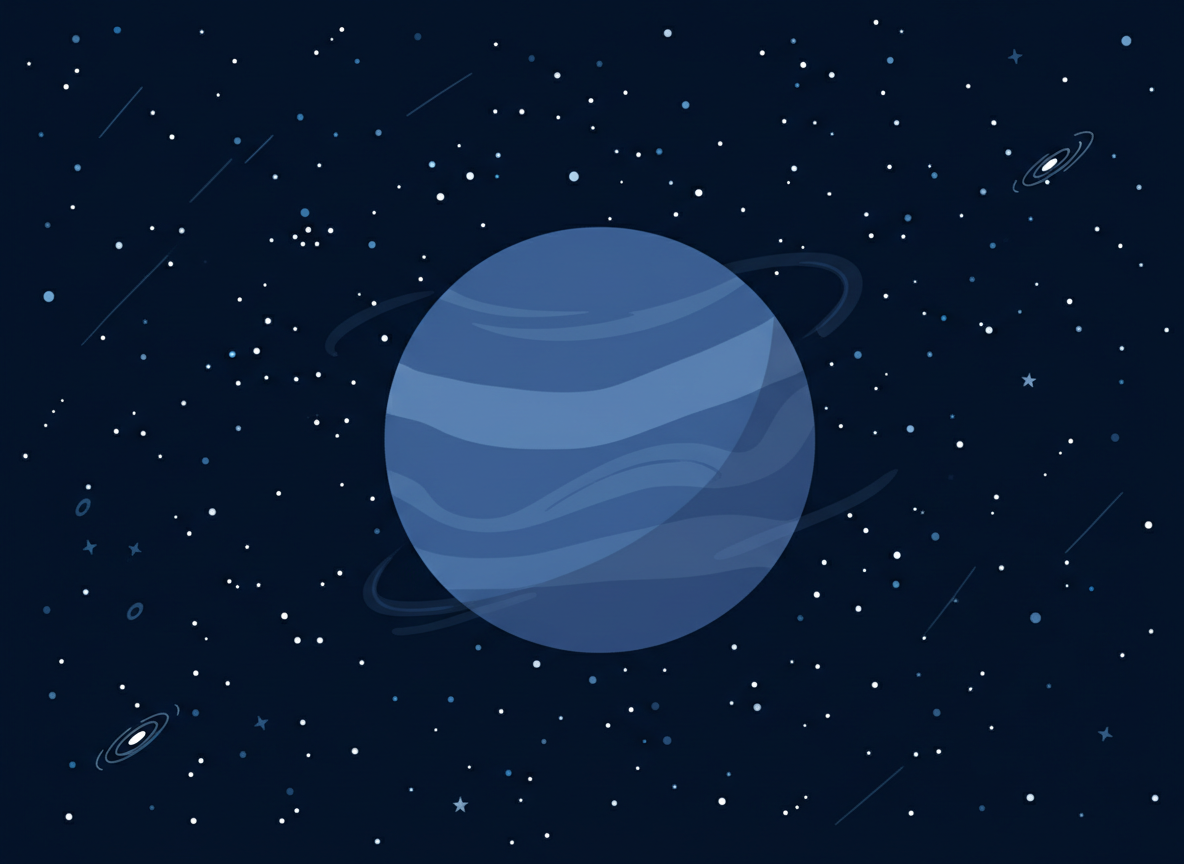

“Whoa, this one’s really far, huh? All the way out at the edge?”
“Yep. Neptune. Last stop in the solar system.”
“It looks so calm. Nothing much happening way out there, right?”
“Actually, it might be the stormiest place in the whole solar system.”
“Wait, what? It’s just a blue dot!”
“Neptune has the fastest winds we’ve ever measured on any planet. Over 2,000 kilometers an hour. Faster than the fastest fighter jet.”
“That’s wild. Why would it be so windy out there? Isn’t it supposed to be freezing and quiet?”
“It is freezing. That’s the strange part — scientists still aren’t totally sure why. Neptune gives off more heat than it actually gets from the sun. All that extra energy has to go somewhere, and it seems to go straight into those winds.”
“So it’s making its own weather? Like it’s got an engine inside?”
“Kind of exactly like that, actually. Most planets rely on the sun to stir things up. Neptune seems to be doing some of it on its own.”
“Is the blue color water, like our oceans?”
“Good guess, but no. It’s methane gas up in the atmosphere. It soaks up the red light from the sun and lets the blue bounce back out to us.”
“How did people even find it? It’s so far and so dark out there.”
“That’s my favorite part of this one. Nobody saw it first. Astronomers noticed the planet next door, Uranus, wasn’t moving exactly the way the math said it should — like something invisible was tugging on it. So they calculated where that something had to be, pointed a telescope at that exact spot…”
“…and there it was?”
“Right where the math said. One night in 1846.”
She’s quiet for a second. “So they found a whole planet before they even looked?”
“Pretty much. The wildest storms in the solar system, and we found the whole planet with math before a single telescope ever caught it.”
Now It’s Your Turn
Find someone this evening and see what you both remember.
- Which planet has the fastest winds in the solar system?
- What color is Neptune, and what makes it that color?
- How did scientists find Neptune before they ever saw it through a telescope?
(Whenever you’re ready: 1. Neptune. 2. Blue — methane gas in its atmosphere soaks up red light. 3. They noticed Uranus being tugged off course, calculated where the pull was coming from, and looked there.)
Maybe tonight, look up and pick one star or light you can’t quite explain — and let that be tomorrow’s question.
답글 남기기